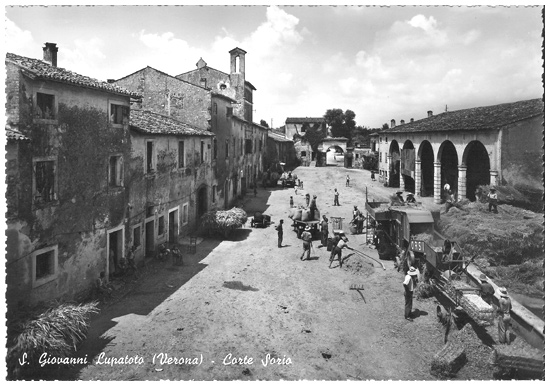
Corte Sorio is universally recognised as “the most famous courtyard in San Giovanni Lupatoto” (Verona). Its renown derives from its intrinsic beauty and its exceptional state of preservation: it has survived substantially intact to the present day, ranking among the oldest courtyards in the municipality.
Medieval Origins
The Earliest Attestations (12th Century)
The community of Sorio emerges in medieval chronicles with the first attestations dating to documents from 1175, as reported by Maestro Giuseppe Lavorenti in his work Storia di San Giovanni Lupatoto. A document of particular significance, the designatio (land survey) of 1178, cites the locality “Allodium Sancti Georgii (now Sorio)”. The term allodium denoted a landed property held in full and free ownership, without feudal obligations — suggesting that Sorio was, in the twelfth century, an important allodial estate.
Some scholars hypothesise that Sorio, given its “remote and isolated position relative to the original central core of the town”, was not originally an integral part of San Giovanni Lupatoto, but rather a distinct entity that was only reabsorbed into the main settlement in more recent times.
The Paquara and the Peace of 1233
The “Via Paquariae (the Paquara)” is mentioned in the same designatio of 1178. Corte Sorio was intrinsically linked to the “great agricultural estate in the Paquara”, the fertile lands that constituted its economic raison d’être.
The historical significance of the Paquara is further underscored by the Peace of Paquara, sealed on 28 August 1233: a great popular assembly presided over by Fra’ Giovanni da Schio that drew an immense crowd. A plaque set into the front of the central tower of Corte Sorio commemorates this event.
The Chiesetta di Sorio (1585)
Foundation
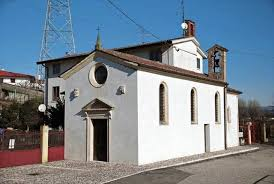
The Chiesetta di Sorio, considered the oldest place of worship in the municipality of San Giovanni Lupatoto, was erected in 1585. Its foundation was due to the “Noble Lady Isotta Borghetti, wife of the Noble Lord Guglielmo Guarienti”. It was dedicated to the Virgin of the Assumption and is also known as the Oratory of St. Peter Martyr (with an additional dedication to Saint George).
Isotta Borghetti established bequests for a chaplaincy to guarantee “two weekday masses per week”, in addition to celebrations on all holy days of obligation. This model of female patronage was typical of the Renaissance and Counter-Reformation period.
Architecture
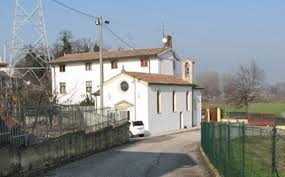
The Chiesetta presents itself as a small oratory with a façade adorned by noble coats of arms. The interior is illuminated by three windows described as Romanesque on the right wall and by a rose window on the façade. Architect Sergio Martin hypothesises that the floor plan shows Renaissance characteristics but may incorporate elements of a pre-existing Romanesque structure, enlarged at different periods.
This architectural complexity is consistent with the medieval origins of Sorio (attested from 1175): the Oratory of 1585 may have been built on the foundations of, or incorporating parts of, an earlier building.
Artistic Heritage
- Apsidal altarpiece: work by an unknown artist, depicting the Virgin with Child and the martyrdom of Saint Peter of Verona
- Side altar: dedicated to the Blessed Virgin and Saints Michael the Archangel and George the Martyr, with a painting dated “D. F. 1610” (possibly a nineteenth-century copy)
- Founders’ altarpiece: preserved in the depositories of the Civic Museums of Verona, it is said to depict Guglielmo di Marco Guarienti and Isotta Borghetti kneeling before the throne of the Virgin — the dating of Guglielmo as “a widower in 1514” would suggest a work predating the Oratory of 1585
- Eighteenth-century tomb slabs and eighteenth-century high altar: catalogued by the General Catalogue of Cultural Heritage
The Patron Families
| Family | Individuals | Period | Contribution |
|---|---|---|---|
| Borghetti | Isotta Borghetti | floruit 1585 | Co-founder of the Oratory; bequest for masses |
| Guarienti | Guglielmo Guarienti | floruit 1585 (and possibly before 1514) | Co-founder; subject of the altarpiece |
| Cartolari | (the noble Cartolari) | 18th–19th c. | Burials in the Chiesetta; donation to the parish |
The noble Borghetti-Cartolari family had burial rights in the Chiesetta. Subsequently, the Cartolari donated the oratory, the adjoining house, and the two adjacent gardens to the parish of San Giovanni Lupatoto, ensuring its preservation under ecclesiastical administration.
The Agricultural Community
“Until the end of the Second World War, the courtyard housed over one hundred people, gathered in some fifteen families devoted to cultivating the great agricultural estate in the Paquara.”
Corte Sorio was a pulsating micro-society, a kind of organised agricultural commune. The numbers — over 100 people, 15 families — indicate a complex communal reality, with established hierarchies, shared labour, and an existence centred on the agricultural cycles.
The community’s decline coincided with the great upheavals of the postwar period: the “economic miracle”, industrialisation, urbanisation, and the mechanisation of agriculture. Families moved towards urban centres, and the Corte ceased to be inhabited in its traditional function.
Chronology
| Date | Event |
|---|---|
| 1175 | First documented mention of Sorio |
| 1178 | Citation of “Allodium Sancti Georgii (now Sorio)” and “Via Paquariae” |
| 1233 | Peace of Paquara (Fra’ Giovanni da Schio) |
| (before 1514?) | Possible altarpiece with Guglielmo di Marco Guarienti and Isotta Borghetti |
| 1585 | Construction of the Chiesetta di Sorio |
| c. 1800 | Beginning of decline (fall of the Venetian Republic) |
| 1900 | Plenary indulgence from Pope Leo XIII |
| post-1945 | Decline of the agricultural community |
| 1982 | Complete restoration of the Chiesetta |
The Corte Today
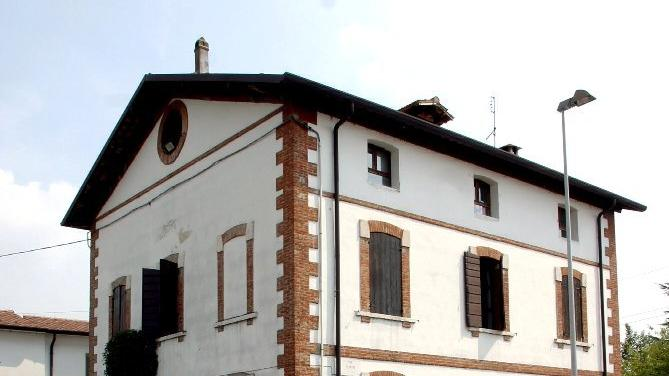
The Chiesetta is officially listed in the General Catalogue of Cultural Heritage. An entity called “Ca’ Sorio” (Via Porto, 260) hosts cultural events such as “Sorio, a Place of Peace, Tells Its Story”. Agricola Corte Sorio di Renato Nicolis & C. S.S. operates as a modern agricultural society, perpetuating the area’s farming legacy.
Sources: G. Lavorenti, Storia di San Giovanni Lupatoto; General Catalogue of Cultural Heritage; Arch. Sergio Martin, architectural study; designatio of 1178.